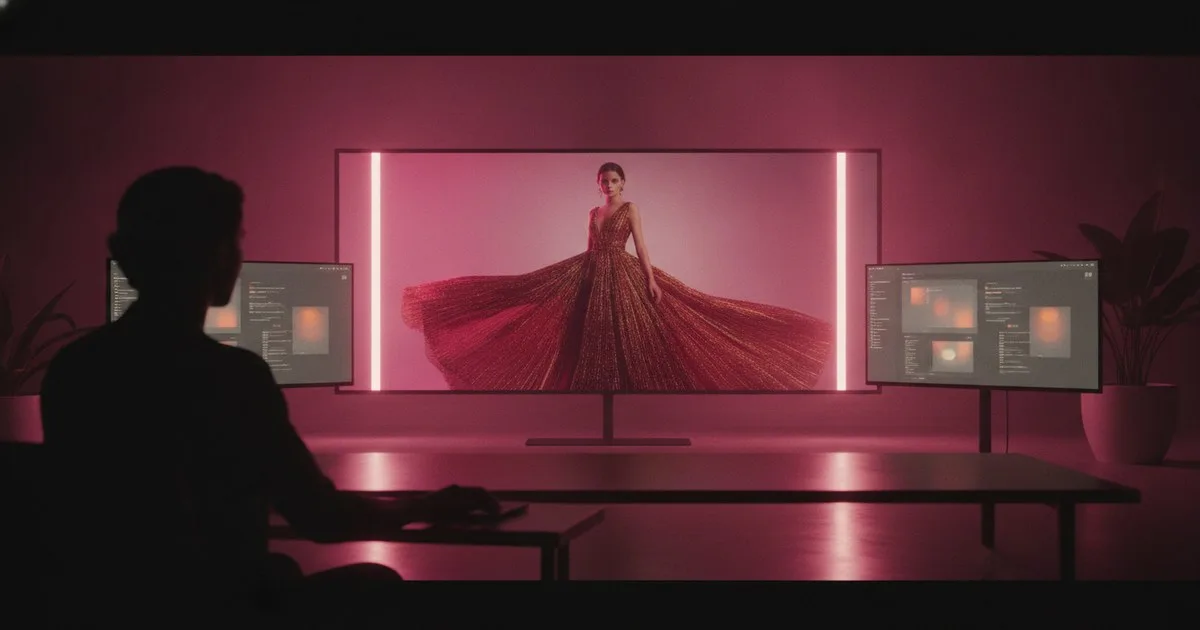
Fashion brands selling online face a stubborn problem: shoppers cannot touch, try or feel a garment before buying, and returns eat margin. DressX started as a catalogue of purely digital clothes and has since repositioned itself as the company that solves exactly that problem at enterprise scale. Today it sells the DRESSX AI Suite, a modular set of AI products built for fashion and luxury commerce — virtual try-on, AI studio, e-commerce imagery and AI shopping guidance.
Key takeaways
- DressX became known for digital-only garments; its current core business is an enterprise AI product suite for fashion commerce.
- The DRESSX AI Suite is modular, meaning brands can adopt individual products rather than a single monolithic platform.
- Virtual try-on is the suite's flagship capability, with luxury clients including Victoria Beckham already using it in production.
- The company is working in the orbit of large platform players exploring virtual try-on as everyday shopping infrastructure.
- Several commercial details — pricing tiers, client headcount, revenue — remain unverifiable from public sources.
What problem does DressX actually solve?
Selling fashion online has always involved a confidence gap. A product image on a white background tells a shopper very little about how a garment will move on their body. Return rates in apparel e-commerce remain among the highest of any category, and the cost — logistical, environmental, financial — falls on brands and retailers.
Traditional solutions have not closed that gap. Static photography is fast to produce but impersonal. Fit-guide copy helps but does not show. Even early virtual try-on tools, built on rigid size charts and 2D overlays, struggled to convey how fabric actually drapes and stretches across different bodies.
DressX's argument, visible across its public positioning, is that the moment for photorealistic, AI-driven try-on at scale has arrived — and that it can deliver it as a modular enterprise product rather than a bespoke integration.
What DressX became known for
The company entered the public conversation as a digital fashion retailer: a place where you could buy a garment that existed only as a file, worn on a photograph of yourself. It was an early and visible bet on the idea that clothing could carry social and expressive value without physical form.
That origin gave DressX a technical foundation — generating convincing digital garments on real human bodies — that turned out to be directly applicable to a much larger commercial problem. The metaverse moment that many predicted did not materialise in the way early enthusiasm suggested, but the underlying capability for placing realistic clothing on photographs of people proved durable and commercially interesting to fashion brands.
A Roblox collection launch, covered by Glossy, illustrated how the company was exploring gaming and virtual worlds as distribution channels for digital garments — an experiment that informed its understanding of how people interact with clothing in digital environments.
What DressX ships today
The DRESSX AI Suite is the company's current product. It is described publicly as a modular, enterprise-grade set of AI tools built for fashion and luxury commerce. The modules cover four areas:
- Virtual try-on: shoppers upload a photo and see themselves wearing a brand's actual garments, with the AI modelling how fabric folds, stretches and drapes on their specific body.
- AI studio: a tool for generating e-commerce imagery without traditional photo shoots.
- E-commerce imagery: production of on-model and product visuals at scale.
- AI shopping guidance: an advisory layer intended to help shoppers find the right product.
The suite is positioned at fashion and luxury brands that want to reduce return rates, lower content production costs and increase conversion — three metrics that have clear board-level visibility.
Who is using it?
Victoria Beckham is among the publicly named clients. WWD reported that the brand partnered with DressX to launch an AI-powered try-on tool allowing shoppers to see how garments move on their own personalised 3D avatars — a deployment that sits squarely in the luxury e-commerce segment DressX is targeting.
The company also operates a consumer-facing mobile app, DX ME, available on the App Store, which functions as an AI clothes-changer and virtual outfit editor. That consumer product appears to serve both a direct audience and as a demonstration layer for the enterprise proposition.
How does the virtual try-on work?
From public descriptions, the technology models fabric behaviour — how specific materials fold, stretch and drape — on a photograph of the shopper's actual body. The output is intended to be photorealistic rather than a schematic overlay. Brands integrate the capability into their own e-commerce environments rather than sending shoppers to a separate platform.
A Forbes analysis of the broader virtual try-on space noted that DressX sits within a stack that includes large platform players working to make virtual try-on feel like everyday shopping infrastructure — a signal of where the category is heading rather than a niche experiment.
For brands considering the AI tools available in fashion commerce, it is worth comparing the DressX approach with retail AI platforms such as Vue.ai, which addresses adjacent problems in product tagging, personalisation and visual search. The two are not direct substitutes: DressX's strength is photorealistic on-body try-on; Vue.ai's is broader retail intelligence. Brands we speak to report that the choice often depends on whether the immediate pain point is conversion at the product page or discovery earlier in the funnel.
Where DressX says it is heading
The public signals point toward deeper enterprise integration and toward the luxury segment specifically. The Business of Fashion has covered the question of how AI-powered virtual try-on can drive luxury conversion, a framing that aligns with DressX's own positioning.
The modular structure of the suite suggests a land-and-expand commercial model: a brand might begin with virtual try-on and later adopt the AI studio or shopping guidance layer. That is a familiar SaaS motion, and it implies the company is building toward deeper, stickier relationships with a smaller number of high-value clients rather than broad horizontal distribution.
The consumer app, DX ME, may serve as both a product in its own right and a channel for demonstrating the technology to potential enterprise buyers — though that reading is an inference from the product architecture, not a stated strategy.
For a broader view of how venture capital is thinking about fashion technology companies at this stage of the cycle, the analysis in Why VCs Pulled Back from Fashion Tech — and What Comes Next is worth reading alongside this profile.
What remains genuinely unclear
Several things about DressX are not verifiable from public sources, and it is worth naming them directly:
- Funding and valuation: no specific funding round amounts or valuation figures are available in the sources reviewed for this profile. Any figure you may have seen elsewhere should be treated with caution unless it links to a primary announcement.
- Client numbers: the company does not appear to have published a client count or a named list beyond the examples that have appeared in press coverage.
- Revenue and growth metrics: no revenue figures or growth rates are available from public sources.
- Pricing: the DRESSX AI Suite's pricing structure is not publicly disclosed in detail.
- Team size: headcount is not publicly confirmed.
These gaps are normal for a company at this stage and in this market. They are worth noting because profiles that fill them with estimates do readers a disservice.
If you are evaluating the DRESSX AI Suite for your own organisation, the questions above are the ones to put directly to the company. For context on how to assess fashion tech vendors more broadly, the framework in PLM in Fashion: Choosing Between Centric, PTC, Backbone, and WFX applies the same rigour to a different product category.
And for anyone tracking where the underlying technology is going, What Cloth Simulation Research Means for Fashion Software Buyers provides useful context on the physics modelling that sits beneath photorealistic virtual try-on.
FAQ
What is the DRESSX AI Suite? It is a modular set of enterprise AI products for fashion and luxury commerce, covering virtual try-on, AI studio, e-commerce imagery generation and AI shopping guidance. Brands can adopt individual modules rather than the full suite.
Is DressX still a digital fashion retailer? Digital garments were its origin. Today its core business is the enterprise AI suite. A consumer app, DX ME, remains active, but the company's primary commercial focus is B2B.
Which brands use DressX? Victoria Beckham is among the publicly named clients, using DressX for AI-powered virtual try-on in its luxury e-commerce environment. Other clients have not been confirmed by name in public sources reviewed here.
How does DressX virtual try-on differ from a size guide? A size guide gives measurements. DressX virtual try-on places a photorealistic rendering of the actual garment on a photograph of the shopper, modelling how the fabric drapes and moves on that specific body.
Where can I find DressX pricing? Pricing is not publicly disclosed. Direct contact with the company is the only reliable route to current commercial terms.
Further reading
- Google, DressX And The New Fashion AI Virtual Try-On Stack — Forbes
- Tech Tuesday: The Digital Twin Takeover — WWD
- WFX
- Vue.ai
- DressX