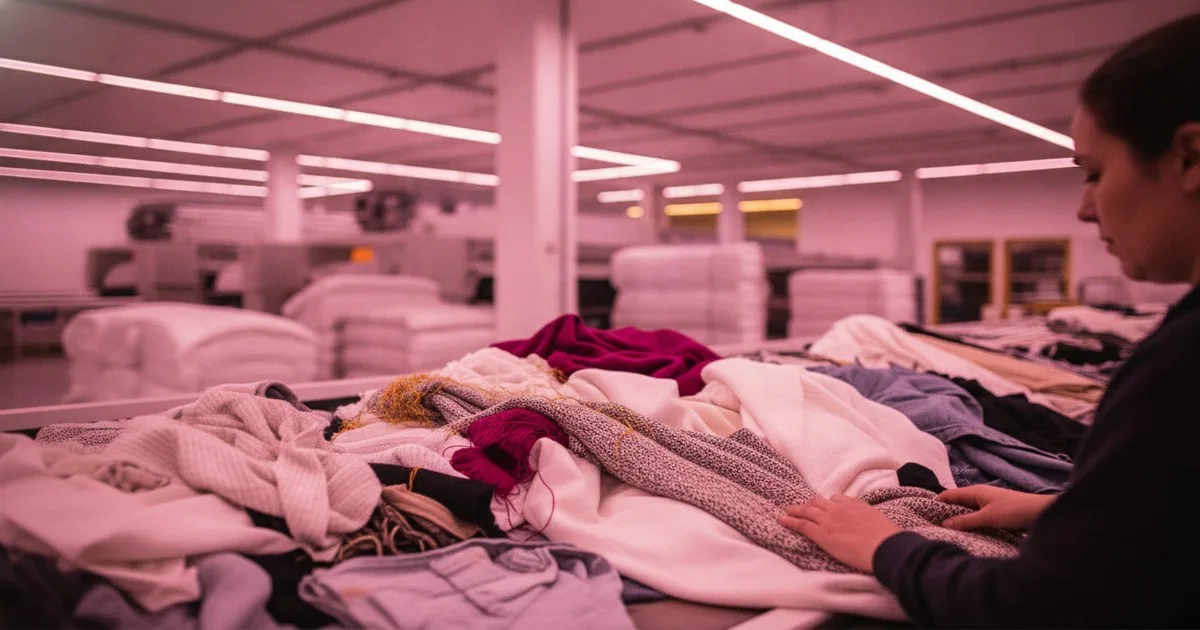
The Ellen MacArthur Foundation has officially joined the American Circular Textiles coalition (AMCIRC) as an Insights Partner to accelerate the transition toward circular textile systems in North America. This collaboration aims to bridge the gap between high-level policy research and practical industry implementation, providing a framework for brands and manufacturers to scale circularity. By combining global research with regional advocacy, the partnership seeks to address the systemic barriers currently preventing the widespread adoption of textile-to-textile recycling and reuse models.
Key takeaways
- The partnership establishes a research-to-action pipeline specifically for the North American textile sector.
- Insights will focus on aligning local policy with global circular design frameworks to ensure consistency for international brands.
- The collaboration targets infrastructure development for collection, sorting, and advanced recycling technologies.
- Success for this initiative requires cross-sector data sharing and robust legislative support to move beyond isolated pilot projects.
What does the Ellen MacArthur Foundation and AMCIRC partnership mean for fashion?
For you as a sustainability lead or innovation officer, this partnership represents a significant shift from fragmented efforts toward a unified strategy for the North American market. The Ellen MacArthur Foundation has long been the primary architect of the global circular economy framework, but its influence has often been felt most strongly in Europe. By joining forces with AMCIRC, the foundation is signaling a deep commitment to the specific logistical and legislative hurdles found in the United States and Canada.
You can expect this partnership to produce more concrete guidance on how to transition from linear "take-make-waste" models to systems where products are used more, made to be made again, and made from safe and recycled or renewable materials. This isn't just about design; it is about the entire lifecycle of a garment. Industry observers at FashionUnited have noted that while many brands have made circularity pledges, the lack of regional infrastructure has been a primary bottleneck. This partnership is designed to identify and remove those specific blocks.
How will this collaboration impact circularity in North America?
Circularity in North America faces unique challenges, including a decentralized waste management system and a lack of federal mandates for textile recycling. The partnership aims to address these by providing the data and insights necessary to advocate for smarter policy. When you look at the current state of the industry, as frequently covered by Sourcing Journal, the focus is often on the "how-to" of recycling, but the "where" and "who pays" remain unanswered.
AMCIRC provides the boots-on-the-ground advocacy, while the foundation provides the global perspective. Together, they will work on:
- Policy Alignment: Ensuring that North American textile legislation doesn't conflict with emerging global standards.
- Infrastructure Mapping: Identifying where investment is most needed for sorting and processing facilities.
- Standardized Metrics: Helping you measure the success of circular initiatives using verified, industry-standard data.
This collaboration is particularly relevant as brands prepare for potential Extended Producer Responsibility (EPR) legislation. Having a clear roadmap from an Insights Partner like the foundation allows your organization to stay ahead of regulatory requirements rather than reacting to them.
What are the primary goals of an "Insights Partner" in this context?
An Insights Partner does not simply sign a pledge; they provide the intellectual engine for the coalition. In this role, the foundation will share its extensive research on circular business models—such as resale, rental, and repair—and help AMCIRC members apply these models within the North American context.
For a business audience, this means access to better data on the economic viability of circularity. You need to know that these systems are not just environmentally sound but also profitable. The foundation’s role is to provide the evidence that circularity can decouple economic growth from the consumption of finite resources. This involves looking at the entire supply chain, from raw material extraction to the final disposal of a garment, and finding the points where value can be recovered.
Comparing Circularity Strategies
| Strategy | Best For | Limits |
|---|---|---|
| Global Frameworks | Standardizing metrics across borders | Often lacks specific local infrastructure detail |
| Regional Coalitions | Driving local policy and collection | Hard to scale without global brand alignment |
| Brand-Led Pilots | Testing specific product circularity | Difficult to achieve systemic change alone |
| Insights Partnerships | Bridging research and implementation | Requires long-term commitment from all stakeholders |
What can go wrong in circular textile partnerships?
Despite the high-profile nature of such collaborations, several factors can impede progress. One major risk is the "pilot trap," where brands launch small, highly publicized circular collections that never scale because the underlying infrastructure—the collection and sorting—is not ready. Without the systemic change AMCIRC is advocating for, these pilots remain marketing exercises rather than business transformations.
Another challenge is data fragmentation. If different regions adopt different standards for what constitutes "recycled content" or "circularity," global brands will struggle to comply. This is why the foundation’s role as a global insights provider is critical; they act as a stabilizing force to ensure that North American efforts are compatible with the rest of the world. Finally, there is the issue of funding. Building the necessary physical infrastructure for textile recycling requires billions in investment, which policy and research alone cannot provide. It requires a concerted effort from both the public and private sectors.
Recent Developments in Circular Fashion
- August 13, 2026: The American Circular Textiles coalition (AMCIRC) and the Ellen MacArthur Foundation announced their partnership to advance circular systems for textiles across North America and globally, as reported by Just Style. This partnership focuses on providing the research and insights necessary to scale circularity in a region that has traditionally lagged behind Europe in textile waste legislation.
FAQ
What is the role of an Insights Partner in circularity?
An Insights Partner provides research, data, and strategic frameworks to help a coalition or organization make informed decisions. In this case, the foundation offers its global expertise in circular design and business models to help AMCIRC navigate the complexities of the North American textile market and policy environment.
Why is North America a focus for circular textiles now?
North America is one of the largest consumers of textiles globally but lacks the integrated recycling infrastructure found in other regions. With emerging state-level legislation and growing consumer demand for sustainable products, there is an urgent need to build a cohesive circular system to manage textile waste effectively.
How does this partnership affect fashion sustainability leads?
Sustainability leads can look to this partnership for standardized metrics and policy guidance. It provides a more predictable environment for investing in circular business models, as the collaboration aims to align North American practices with global standards, reducing the risk of non-compliance with future regulations.
What are the expected outcomes of the AMCIRC and EMF collaboration?
The collaboration is expected to produce policy recommendations, infrastructure roadmaps, and educational resources for the industry. The long-term goal is to establish a self-sustaining circular economy for textiles where waste is designed out and materials are kept in use at their highest value.