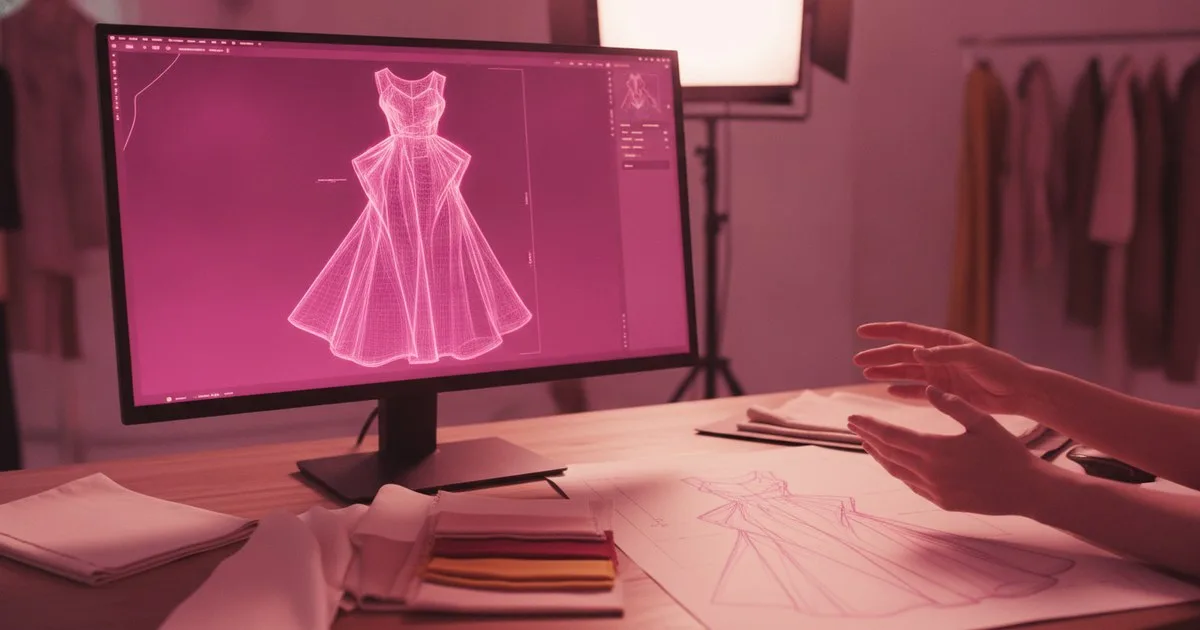
Browzwear has been in the 3D garment simulation business longer than most fashion-tech startups have existed. While newer entrants have competed for market share, Browzwear has quietly expanded its platform from a specialist simulation tool into something it now describes as an end-to-end digital product creation environment. For brand digital-product-creation leads evaluating where to anchor their 3D workflow, that distinction matters.
Key Takeaways
- Browzwear's core product, VStitcher, remains one of the most established 3D garment simulation tools in the industry, used by brands across sportswear, denim, and woven categories.
- The platform has expanded well beyond simulation: Stylezone handles digital asset management and collaboration, and the recently introduced Whiteboard adds AI-powered ideation directly inside the same environment.
- The 2026.1 release signals a deliberate push toward connecting concept through to production handover, reducing the tool-switching that costs product teams weeks per season.
- Browzwear's material ecosystem — including a bonded-material library built with adhesive manufacturer Bemis — reflects a strategy of embedding supplier data inside the simulation rather than treating it as a separate reference.
- Several questions about customer scale, revenue trajectory, and competitive differentiation remain genuinely unanswerable from public sources alone.
What did Browzwear become known for?
Browzwear built its name on VStitcher, a 3D garment simulation tool designed for apparel professionals rather than for game artists or film VFX teams. Where general-purpose 3D software required specialists to adapt tools built for other industries, VStitcher was constructed around the logic of pattern-making and fabric behaviour. Brands in performance wear, denim, and structured wovens — categories where fit and material drape are non-negotiable — became its natural early customers.
The core proposition was straightforward: replace physical sample rounds with digital ones. A brand that might have produced four or five physical samples per style before a final approval could, in principle, reduce that to one or two, cutting both lead time and the cost of shipping prototypes across continents. That promise resonated in an industry where sample costs and calendar pressure were already acute, and it gave Browzwear a durable foothold before the broader fashion-tech wave arrived.
What does Browzwear actually ship today?
The product suite has grown considerably from its VStitcher roots. As of the 2026.1 release, Browzwear describes its platform as covering the full arc from first creative spark to production-ready output — a positioning that would have been unusual for the company a few years ago.
VStitcher
VStitcher remains the simulation engine at the centre of the platform. It handles pattern-to-3D construction, fabric physics, and the production of digital twins that can be used for internal review, supplier communication, and increasingly for e-commerce imagery. The multi-layered material feature — which lets teams stack and independently manipulate fabric layers, all-over prints, and seam textures — gives designers finer control over how a garment's surface reads in a digital render without losing the underlying construction logic.
Stylezone
Stylezone functions as the collaboration and digital asset management layer. It is where teams review styles, manage approvals, and share assets across functions — design, merchandising, and product development. The AI tools that Browzwear has been building out live inside Stylezone: a similarity-recognition feature that can surface related garments even when metadata is incomplete, and text-to-sketch concept generation. Browzwear's own documentation is careful to note that these AI tools learn from training data, not from a brand's proprietary work — a point that matters to any enterprise customer thinking about IP exposure.
Whiteboard
The most recent addition is Whiteboard, an AI-powered ideation space integrated directly into Stylezone. Before Whiteboard, teams were typically running moodboarding and concept-sharing across external tools — Miro, Figma, shared drives, email threads — then translating the output into the product development environment. Whiteboard is designed to collapse that gap: moodboarding, concept exploration, team annotation, and e-commerce image creation sit inside the same platform where the actual garments live. The 2026.1 release describes this as eliminating the context loss that happens every time a handover crosses a tool boundary.
Material partnerships
One of the less-discussed parts of Browzwear's current strategy is its material ecosystem. The partnership with Bemis — a manufacturer of adhesive bonding films and seam tapes — resulted in a library of 17 bonding materials inside VStitcher, covering stretch and non-stretch films and a range of seam treatments. For brands working in technical outerwear, activewear, or any category where bonded construction is standard, this means the simulation can reflect actual supplier materials rather than approximations. It is a model that points toward a broader ambition: making the digital twin accurate enough that what you see in VStitcher is genuinely predictive of what comes off the production line.
Where is Browzwear heading next?
The direction of travel from the 2026.1 release is legible even without an investor roadmap. Browzwear is moving toward a platform model — one where the value is not just in any single tool but in the connections between them. Concept in Whiteboard flows into construction in VStitcher, which flows into review and approval in Stylezone, which flows into the handover package a factory receives. Each link in that chain that Browzwear can own reduces the friction that currently costs product teams weeks per season.
The AI layer is being built incrementally and, notably, with explicit guardrails communicated to users. The documentation around AI in Stylezone addresses trust and creative control directly — acknowledging that AI is neither magic nor infallible, and positioning the tools as assistants rather than replacements. That framing is deliberate. Brand teams at the level Browzwear serves have lived through enough overpromised automation to be sceptical, and a vendor that names the limits of its own tools tends to earn more durable trust than one that does not.
Material library expansion — more supplier partnerships like the Bemis collaboration — seems a natural extension of the current strategy. If the simulation is only as credible as the material data inside it, then growing the library of verified supplier materials is a direct investment in the accuracy of every digital twin a brand produces.
Events like PI Apparel have consistently surfaced Browzwear as a reference point in conversations about digital sampling adoption, which suggests the company remains visible at the level where enterprise buying decisions are shaped.
What do public sources not tell us?
This is worth naming honestly. Several things that would matter to a brand evaluating Browzwear are not verifiable from public information.
Customer scale and retention. Browzwear is known to work with major brands across sportswear and denim, but the number of active enterprise accounts, renewal rates, and the depth of deployment — whether brands are using VStitcher for a handful of styles or across their full line — is not publicly disclosed.
Competitive differentiation in practice. Marvelous Designer addresses a partially overlapping need, particularly in entertainment and gaming pipelines, and has a significant user base among independent designers and studios. How the two tools compare in a rigorous production environment — on simulation accuracy, pattern fidelity, or the speed of the review cycle — is not something public sources can settle. Brands we speak to report that the choice often comes down to workflow integration and where a team's existing skills sit, rather than any single feature.
Funding and ownership. No funding round or ownership structure for Browzwear is verifiable from the sources available to this publication. We will not speculate.
AI accuracy in production conditions. The AI ideation and similarity-recognition tools are new enough that independent, production-scale assessments do not yet exist in public. Browzwear's own documentation is appropriately cautious; whether that caution reflects the current state of the tools or a conservative communications posture is something only a live evaluation can answer.
FAQ
What is Browzwear VStitcher used for? VStitcher is a 3D garment simulation tool used by apparel brands to build digital twins of garments from pattern files, simulate fabric behaviour and fit, and reduce the number of physical samples needed before production approval.
How does Browzwear differ from Marvelous Designer? Both tools handle 3D garment simulation, but Browzwear positions VStitcher as part of an end-to-end product creation platform for enterprise apparel brands, while Marvelous Designer has a strong following among independent designers, game artists, and studios. The practical difference in a production context depends on workflow integration and team skills.
What is Browzwear Stylezone? Stylezone is Browzwear's collaboration and digital asset management layer, where teams review styles, manage approvals, and access AI tools including text-to-sketch generation and garment similarity recognition.
What is Browzwear Whiteboard? Whiteboard is an AI-powered ideation space inside Stylezone that brings moodboarding, concept exploration, and e-commerce image creation into the same environment as the garments themselves, reducing the tool-switching that slows product teams down.
Does Browzwear's AI train on a brand's proprietary designs? According to Browzwear's own documentation, the AI tools in Stylezone learn from training data, not from a brand's own work — a point the company addresses directly in its published guidance on AI trust and creative control.
Further reading
- Browzwear 2026.1: Closing the Gaps in Your Digital Fashion Workflow
- From Sketch to Style: Introducing AI Ideation in Whiteboard
- AI in Stylezone: Tools, Trust & Creative Control
- Bemis and Browzwear Launch Innovative Material Bonding Library
- Marvelous Designer
- Optitex