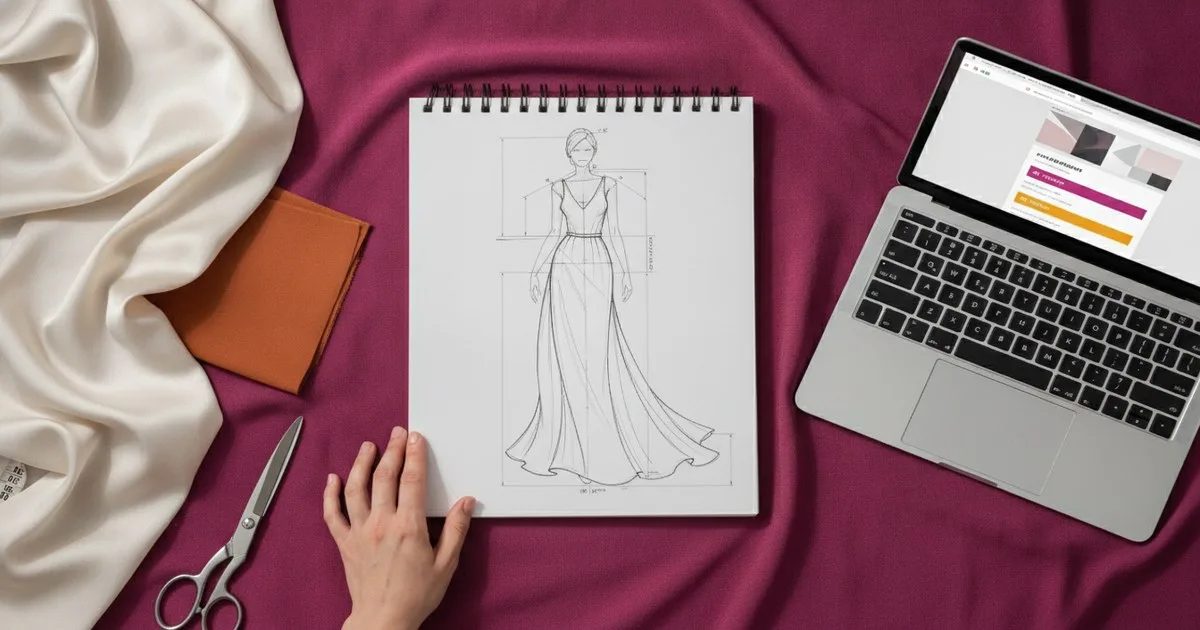
The domain ca.la no longer introduces a company called Cala. It now presents Mercer, described in its own words as 'the leading platform for independent designers, small fashion houses, and established fashion brands to unify development, production, and logistics into a single platform.' The name changed; the ambition grew. What the company became known for, what it actually ships today, where it says it is heading, and what remains genuinely opaque from public sources — those are the four things worth understanding.
Key takeaways
- Cala, the sketch-to-ship supply-chain service for emerging brands, has rebranded as Mercer and repositioned as an all-in-one product design platform.
- Mercer targets a wide spectrum of customers, from independent designers to established fashion brands, under a single unified platform promise.
- The platform supports multiple starting points — inspiration photos, hand sketches, CADs, tech packs and AI-assisted starts — and connects design directly to production and logistics.
- Critical details including rebrand timing, ownership structure, pricing and active customer count are not confirmed in any specific public source.
- The rebrand signals a shift from service-led supply-chain facilitation toward software-led product development, a direction several fashion-tech companies are navigating simultaneously.
What did Cala become known for?
Before the Mercer name appeared on ca.la, the company operated as Cala and built a reputation as a bridge between emerging fashion brands and the manufacturing infrastructure those brands could not otherwise access. The core proposition was practical: a brand with a sketch and a concept could hand off the hard parts — sourcing, sampling, production coordination — and receive finished goods without assembling its own supply-chain team.
For independent designers and small labels, that was a meaningful offer. Building supplier relationships, managing quality control across factories, and navigating logistics are skills that take years and relationships to develop. Cala compressed that learning curve into a managed service. The company became a reference point in conversations about democratising fashion manufacturing, and it appeared regularly in coverage by trade publications including Sourcing Journal.
That origin story matters because it explains the customer instinct Mercer is now building on: users who came for supply-chain help and stayed for the platform.
What does Mercer actually ship today?
The current product, as described on ca.la, is a web-based platform that brings design, development, production and logistics under one interface. The positioning language has moved away from 'managed service' and toward 'scalable tool' — a shift that suggests the company is investing in software infrastructure rather than purely in human coordination.
Where you can start
Mercer describes several entry points for a new product:
- Inspiration photos — upload references and begin shaping a direction visually
- Hand sketches — digitise and develop from rough drawings
- CADs — import existing technical drawings and continue from there
- Tech packs — bring structured specification documents into the workflow
- AI-assisted starts — use built-in AI tools to generate a starting point from a prompt or concept
The promise across all of these is the same: 'shave weeks off your timeline,' in the platform's own phrasing. Whether that claim holds across different product categories and complexity levels is not something public sources can confirm.
Who it is built for
Mercer names three customer types explicitly: independent designers, small fashion houses and established fashion brands. That is a wider target than Cala's original focus on emerging labels, and it raises a genuine question about where the platform's depth is strongest. A tool that serves a solo designer and an established brand simultaneously is making a significant product promise. The platform does not publish case studies or named customers in a form that would let an outside observer test that claim.
For teams already exploring AI-assisted design generation, it is worth knowing that adjacent tools exist with different specialisations. Refabric, for instance, focuses specifically on AI design generation, photoshoot simulation and print work for apparel teams — a narrower scope than Mercer's end-to-end ambition, and one that may complement rather than compete with a supply-chain-oriented platform. Our profile of Refabric's AI design generation approach covers that distinction in more detail.
Where is Mercer pointing next?
The platform's current language — 'all-in-one,' 'scalable,' 'unprecedented ease' — points toward a software-as-a-service model that can grow with a brand rather than a project-by-project service relationship. That trajectory is consistent with where fashion-tech investment attention has been concentrating: tools that sit inside a brand's daily workflow and accumulate data and dependency over time are more defensible than one-off service engagements.
The inclusion of AI-assisted design starts is also notable. It positions Mercer not just as a production facilitator but as a creative starting point, which is a different and more upstream relationship with the customer. Whether the AI layer is proprietary or built on third-party models is not disclosed in public-facing material.
For context on how the broader category is evolving, Sourcing Journal covers supply-chain technology and platform consolidation in fashion on an ongoing basis — useful background for anyone tracking where Mercer sits in a moving field.
The profile of Heuritech, now part of Luxurynsight, offers a parallel case study in how fashion-tech companies reposition and consolidate as they mature — a pattern Mercer's rebrand echoes, even if the specifics differ.
What public sources do not tell us
This is the section that matters most for anyone making a business decision.
The rebrand timing is not confirmed in any specific dated article available at the time of writing. Ca.la presents Mercer as the current product, but when the Cala name was retired and the Mercer identity launched is not established by a public source with a verifiable date.
Ownership and investment are similarly opaque. Whether the company has raised external capital, who holds equity, and whether any acquisition or restructuring accompanied the rebrand are all questions that public sources do not currently answer.
Pricing is not published on the platform's public pages in a form that allows direct comparison. Brands evaluating Mercer will need to engage the sales process to understand cost.
The active customer base — its size, composition and geographic spread — is not disclosed. The platform claims to serve independent designers through to established brands, but without named customers or independently verified case studies, that range cannot be confirmed.
Manufacturing network depth — which factories, which regions, which product categories — is also not detailed in public-facing material. For a platform whose value depends on production access, that is a meaningful gap for a prospective customer to probe directly.
None of these gaps are unusual for a company in active transition. They are, however, the right questions to ask before committing a development workflow to any platform.
FAQ
What is Mercer in fashion? Mercer is the current name for the platform previously known as Cala. It describes itself as an all-in-one product design platform for independent designers, small fashion houses and established brands, covering design, development, production and logistics in one web-based tool.
Did Cala get acquired or just rebrand? Public sources confirm only that ca.la now presents the Mercer product. Whether the rebrand involved an acquisition, a restructuring or a straightforward name change is not established by any specific public source available at this time.
What can you do with Mercer that you could not do with Cala? Mercer's public positioning adds AI-assisted design starts and a broader software platform framing to what Cala offered as a supply-chain service. The full feature delta is not documented in a public changelog or press release.
Is Mercer suitable for large fashion brands? The platform explicitly names established fashion brands as a target customer. Whether its manufacturing network and software depth match enterprise-scale requirements is not verifiable from public sources alone — that is a question for a direct evaluation.
How does Mercer compare to AI design tools like Refabric? Mercer positions itself as an end-to-end platform from design through logistics. Refabric focuses specifically on AI design generation, photoshoot simulation and print work. The two address different parts of the product development process and may be complementary depending on a team's workflow.