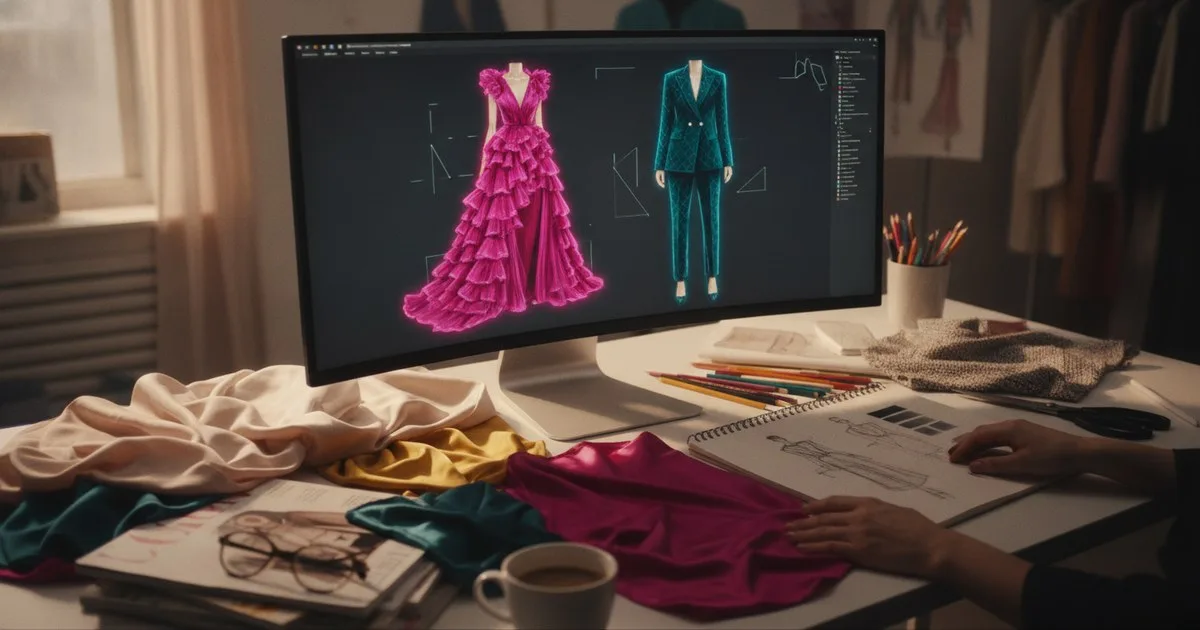
Raspberry AI is a New York-based generative AI platform built specifically for fashion design and product development teams. It positions itself not as a general-purpose image tool repurposed for apparel, but as a creative system designed from the ground up for the way brand teams actually work — across design, product, and marketing in a single environment.
Key Takeaways
- Raspberry AI was named the only creative application on the CB Insights 2026 AI 100, selected from more than 40,000 startups globally.
- The platform spans sketch-to-render, on-body virtual try-on, repeating print generation, and AI product photography — all under one roof.
- Its Boards product, now in open beta, is designed to replace the fragmented loop of file-sharing and feedback that slows down most design teams.
- The company claims brands can compress tasks that once took weeks — sketching, sampling, photoshoots — into hours, though independent verification of that figure is not publicly available.
- Key integration and workflow details, funding history, and customer names remain largely absent from public sources.
What did Raspberry AI become known for?
Raspberry AI built its early reputation on a specific frustration: fashion design teams spending hours coloring sketches or reworking CADs, only to discover errors late in the process or struggle to communicate a concept across functions. The company's answer was instant visualization — the ability to see how a print, texture, or color-blocking decision would look on a garment before a single sample was cut.
That core promise — see it before you sample it — gave the company a clear hook in a market where the alternative was either expensive physical sampling or slow, specialist-dependent 3D workflows. It also gave it a story that resonated with brand design directors who had lived through exactly that problem.
What does Raspberry AI actually ship today?
The product range has expanded well beyond early visualization. As of mid-2026, Raspberry AI describes itself as one creative system across design, product, and marketing teams. The current product set includes:
Sketch-to-render and instant visualization Designers can move from a rough sketch or reference image to a photorealistic render without leaving the platform. The tool handles prints, textures, and color-blocking, and is aimed at reducing the back-and-forth between design and product teams that typically slows early-stage development.
Repeating print and graphic generation The platform generates repeating prints and surface graphics, a capability that sits at the intersection of design and production-readiness — useful for teams working on seasonal collections at volume.
On-body virtual try-on Garments can be placed on 3D avatars and rendered to photorealism, giving teams a way to evaluate fit and proportion without physical samples.
AI product photography This module generates studio-grade product shots — for lookbooks, product-detail pages, editorial campaigns, and digital catalogs — without a physical studio or photographer. The company positions it as suitable for ready-to-wear garments, shoes, and accessories, with what it describes as maximum control over presentation.
Boards (open beta) The most recent addition is Boards, a collaborative creative workspace that entered open beta with 300 free credits available across Basic, Pro, and Enterprise plans. The problem Boards is designed to solve is structural: design is collaborative, but the standard workflow — sketch, share, get feedback, iterate, share again — fragments creative work across email threads, messaging apps, and disconnected file versions. Boards is Raspberry AI's attempt to bring ideation, feedback, and creation into one persistent environment.
Workflow integrations Raspberry AI has built connections to external product planning tools, allowing AI-generated designs to be exported directly into collection planning and visualization environments used by merchandising, planning, and sales teams. The intent is to ensure that creative work produced in Raspberry AI does not sit in a silo but flows immediately into downstream commercial decisions.
How does Raspberry AI compare to other AI design tools?
The AI design generation category now includes several active players. Refabric is one of the more directly comparable platforms — it covers AI design generation, print work, and AI photoshoot capabilities, with published applications in performance and sportswear. Both platforms target brand design teams rather than individual creators, and both offer some form of AI-generated imagery for product visualization.
Where Raspberry AI differentiates publicly is in its breadth: the combination of sketch-to-render, on-body try-on, print generation, product photography, and now a collaborative workspace in Boards is a wider surface area than most single-capability tools. Whether that breadth translates into deeper adoption at the enterprise level is not something public sources confirm.
| Tool | What it is | Best for | Public limits |
|---|---|---|---|
| Raspberry AI | End-to-end generative design platform | Brand teams across design, product, marketing | Funding, customer names, pricing not public |
| Refabric | AI design generation and photoshoot | Apparel teams, performance/sportswear focus | Narrower workflow integrations publicly documented |
Where is Raspberry AI heading?
The CB Insights 2026 AI 100 recognition — where Raspberry AI was named the only creative application on a list drawn from more than 40,000 startups — is the clearest public signal of where the company sits in the market's estimation. CB Insights selects companies based on factors including patent activity, investor profile, and market potential; inclusion does not guarantee outcomes, but it does reflect a considered external view.
The direction of travel from the product roadmap is toward deeper workflow integration. The Boards launch suggests Raspberry AI wants to own more of the creative process — not just the moment of generation, but the collaboration, iteration, and handoff that surround it. The integration with external collection planning tools points in the same direction: becoming the system of record for creative decisions, not just a generation utility that sits outside the main workflow.
The company's stated positioning — accelerating speed to market by compressing weeks of work into hours — is ambitious. Whether that claim holds across the full range of brand sizes and product categories is not something public sources verify independently.
What do public sources not tell us?
Several things that matter to investors and potential enterprise customers are genuinely absent from public information:
- Funding history. No funding rounds, investors, or total capital raised appear in any source available at the time of writing. The company may be venture-backed, bootstrapped, or at a stage where it has not made funding public — none of these can be confirmed.
- Customer names and scale. Raspberry AI does not publicly name brand customers or disclose the size of its user base. The claim that it serves design, product, and marketing teams is a positioning statement, not a verified customer list.
- Pricing structure. The existence of Basic, Pro, and Enterprise plans is mentioned in the Boards beta announcement, but pricing for those tiers is not disclosed in public sources.
- Founding date and team. The founding story and team composition are not detailed in the sources available here. What is known is where the company is now, not the precise path that got it there.
- Independent performance data. The speed-to-market claims on the product pages are company-stated figures. No third-party benchmarks or published case studies with verifiable metrics appear in public sources.
For founders and investors evaluating Raspberry AI, those gaps are worth noting. The product surface is broad and the external recognition is real. The commercial specifics require a direct conversation.
FAQ
What does Raspberry AI do? Raspberry AI is a generative AI platform for fashion brand teams. It covers sketch-to-render visualization, repeating print generation, on-body virtual try-on, AI product photography, and a collaborative workspace called Boards — all positioned as one system for design, product, and marketing teams.
Who is Raspberry AI built for? The platform targets brand design and product teams at fashion companies, not individual creators or small studios. Its workflow integrations and Enterprise plan suggest a focus on organizations with cross-functional teams spanning design, merchandising, and marketing.
Has Raspberry AI raised funding? No funding rounds or investor names appear in publicly available sources at the time of writing. This information has not been confirmed or denied publicly.
What is Raspberry AI Boards? Boards is a collaborative creative workspace, currently in open beta, designed to replace fragmented file-sharing and feedback loops. It brings ideation, iteration, and creation into one environment, with 300 free credits available on launch for Basic, Pro, and Enterprise plan users.
How does Raspberry AI differ from general image generation tools? Raspberry AI is built specifically for fashion workflows — print generation, garment visualization, on-body try-on, and product photography — rather than adapted from a general-purpose model. Its integrations with collection planning tools are also fashion-specific, not generic.
Further reading
- Introducing Boards Open Beta — Raspberry AI
- Raspberry AI Named to CB Insights 2026 AI 100
- AI Product Photography — Raspberry AI
- Refabric
- Cala
- DressX